Onet Puzzle - Tile Match Game
- 4.6
- Rating
- 50.00M
- Installs
- Free
- Price
 Analysis by App-foxy
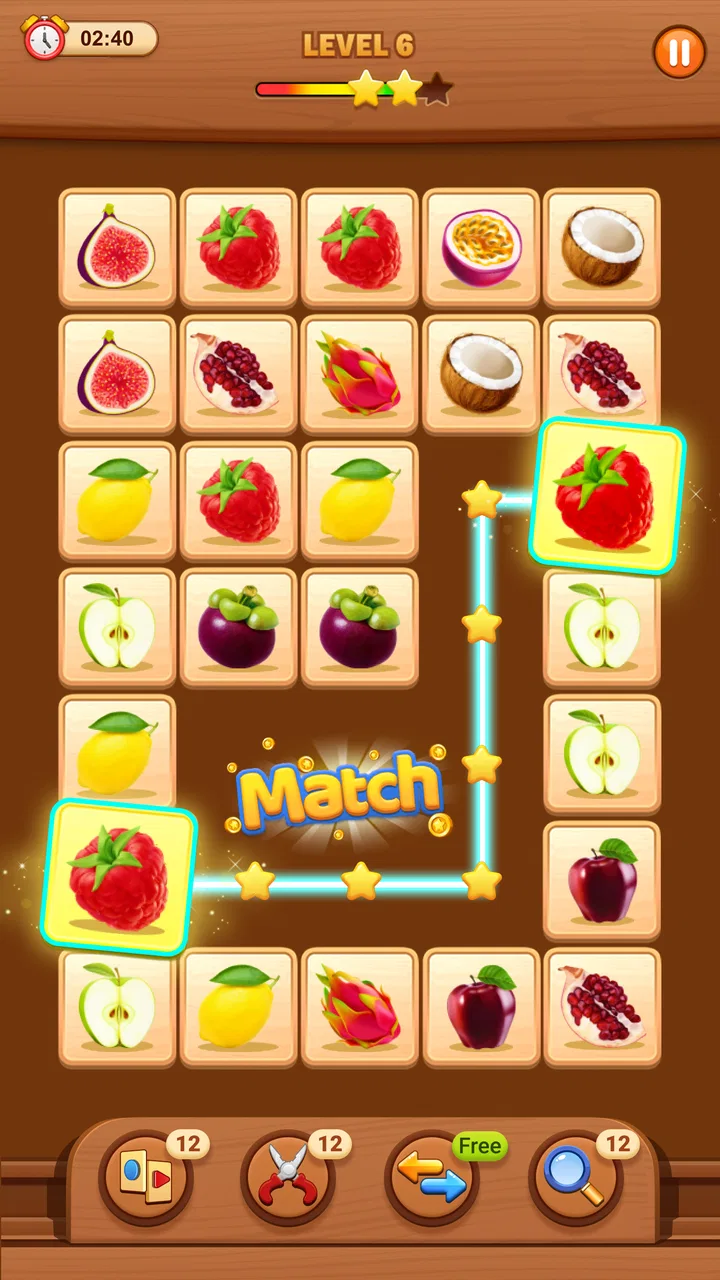
I can lose track of time with a good matching puzzle, but I also notice quickly when one becomes noisy, repetitive, or too demanding. Onet Puzzle - Tile Match Game takes a quieter route. The first thing I do is look across the board for two identical tiles that can be connected by a clear path. When the connection works, both tiles disappear, the board opens up, and I immediately start scanning for the next useful pair. That simple action-feedback cycle is the reason this board game feels easy to begin yet surprisingly difficult to put down.
My experience with it is best described as a relaxed visual workout rather than a competitive strategy game. The basic objective is familiar, but the pressure comes from seeing the board as a changing set of possibilities. A pair that looks obvious may not be connectable, while a less noticeable pair can become the key to opening an entire section. I enjoy that small shift in attention: I am not merely matching pictures, I am deciding which match will leave the board in the most manageable shape.
How the matching loop feels in actual play
I find the matching loop easiest to enjoy when I treat each successful pair as a reason to pause, not just a cue to tap again. That brief reset helps me notice newly opened routes and avoid circling the same crowded patch of tiles. The sections that follow look at the practical snags that can interrupt this otherwise simple rhythm, and how I approach them without assuming every slowdown is the game’s fault.
You May Also Like

 AccuWeather: Weather Radar
AccuWeather Review: A Quick, Clear Forecast for Everyday Decisions
For everyday plans, the best forecast is the one you can understand quickly. AccuWeather makes rain timing, radar, and local conditions easy to act on, with a few trade-offs.

 Hill Climb Racing
Why Hill Climb Racing Still Turns Crashes Into One More Run
A tiny car, a bumpy hill and one more upgrade: Hill Climb Racing keeps resurfacing because its simple chaos makes every near-miss feel personal.

 AliExpress - Shopping App
AliExpress Makes Global Shopping Feel Personal, but Shoppers Bear the Risk
AliExpress turns a global marketplace into a pocket-sized discovery engine. Its reach is useful, its shopping loop compelling, and its trade-offs easy to miss.

 Lords Mobile: Kingdom Wars
Lords Mobile Is a Kingdom-Building Routine, Not a Quick Match
A case-by-case verdict on the building, battles, device demands, and social commitments that make Lords Mobile rewarding for some players and exhausting for others.

 PDF Scanner app - TapScanner
TapScanner Makes Paperwork Easier to Capture, Check, and Share
TapScanner makes scanning with a phone feel less like a rescue operation and more like a dependable step in getting work done. Its capture tools are useful, though not flawless.

 Block Blast!
 Shows How Much a Puzzle Game Can Leave Out
A quiet grid game shows why puzzle players increasingly value instant clarity, repeatable skill and low-pressure play—and where the genre still needs to catch up.
More From Our News Desk
View All News


The first move is simple, but the board teaches you to look twice
Starting a round requires almost no explanation. I search for two matching tiles, tap them, and watch whether the game accepts the connection. That immediate response makes the game approachable for people who do not usually play board puzzles. There is no complicated opening setup to learn, and the visual goal is clear from the moment the board appears.
The interesting part begins after the first few removals. The board is not just a collection of pairs waiting to be found; it is a layout in which position matters. Clearing one pair can expose another, create a corridor, or remove a visual obstacle that had made a match difficult to notice. I have found that the most useful habit is to pause after every successful connection instead of tapping quickly through the board. The screen changes enough that yesterday’s scan is no longer reliable.
This is also where the game separates itself from a basic memory-matching title. I am not turning cards over and trying to remember hidden locations. The challenge is spatial reading: identifying equal tiles and judging whether the route between them is available. That makes it a better fit for someone who likes visual sorting and light planning than for someone looking for a traditional card-memory exercise.
The tile artwork keeps the task readable, although busy boards can still make similar-looking symbols blend together. On a smaller phone screen, I sometimes slow down simply because I want to distinguish nearby designs before committing to a tap. That is not a serious flaw, but it is a reminder that the game rewards careful observation more than frantic speed.
Every successful pair creates a small, satisfying reset
The feedback is immediate and easy to understand. A correct pair disappears, the board becomes less crowded, and I get a clear visual sign that the decision worked. That response is important because the game does not need elaborate storytelling to motivate the next move. The reward is visible progress: fewer tiles, more open space, and a better chance of spotting the next connection.
I like the rhythm because it alternates between action and inspection. I make a match, receive confirmation, then stop for a brief reevaluation. In many casual puzzle games, the best move is to continue tapping while the momentum is high. Here, momentum can actually make me careless. The useful feedback is not only the disappearance of a pair; it is the new arrangement left behind.
One practical technique has improved my results: I first look for pairs that sit near the edges or in open areas, then reconsider the center after the layout has loosened. This is not a guaranteed solution, but it reduces the chance of spending too long staring at a dense cluster. Another helpful approach is to avoid removing a pair merely because it is available. If two choices are equally obvious, I choose the one that seems likely to open more lines of sight.
That kind of decision gives the game more depth than its short description suggests. The app remains accessible, yet it quietly asks me to think about consequences. I do not need advanced puzzle knowledge, but I do need to notice how one removal changes the next five seconds of play.
The reward is progress, not spectacle
Onet Puzzle works best when I want a modest sense of accomplishment. Clearing a difficult section feels good because the board visibly moves from cluttered to organized. The reward is especially effective during short breaks: I can play for a little while, solve a few connections, and stop without feeling that I have abandoned a long story or a complicated campaign.
The game is free to play, which makes trying it straightforward. Optional purchases range from under a dollar to several dozen dollars per item, so I would advise checking the purchase screen carefully before confirming anything. The free entry point is useful for casual players, but the presence of in-app purchases means I would not hand the device to a child without first considering the account’s purchase controls, even though the game itself carries an Everyone age rating.
For me, the strongest reward is the feeling of restoring order. A crowded board can look almost unsolvable until one good match creates breathing room. That transformation is more meaningful than a flashy animation would be. It also explains why I often begin another round after finishing one: the previous board has given me a short, clean success, and I want to see whether I can make the next layout flow just as smoothly.
There is a trade-off here. Players who need constant novelty, competitive rankings, or a strong narrative may find this reward system too restrained. The appeal depends on enjoying the act of noticing patterns. If matching tiles feels like busywork to you, the game is unlikely to change your mind simply through presentation.
A realistic use case: a quiet ten-minute break
I see this game fitting naturally into a waiting room, a commute with a seat, or the few minutes before bed when I want something more active than scrolling but less intense than an action game. I can open it, make several careful matches, and put the phone down when my attention is needed elsewhere. The board-based format makes it easy to understand again after a pause because the objective remains visible.
It also suits someone who wants a low-pressure activity for improving visual concentration. I would not call it a formal training tool, and I would not expect it to replace a dedicated brain-training program, but it does encourage repeated scanning, comparison, and short-term planning. The useful part is that these skills are practiced inside a clear goal rather than through abstract exercises.
For a family setting, the Everyone rating makes the theme broadly approachable. Still, younger players may need help with the spatial rule if they expect any two identical tiles to match automatically. The game’s central lesson is that similarity is only the first condition; the route between the tiles matters too. Explaining that distinction once is usually enough for a new player to understand what the board is asking.
What happens when a session stalls
The reset is a major part of the loop. Eventually I reach a point where the board feels locked, my eyes keep returning to the same few tiles, and progress slows to a crawl. That moment can be frustrating, especially if I believe I missed an obvious connection. Instead of treating the stalled board as a failure, I use it as a signal to stop scanning randomly and restart my search methodically.
I check the outer edges first, then compare identical designs in separate regions, and finally inspect whether a recently cleared space has created a route I overlooked. This deliberate reset often reveals a move. When it does not, beginning again is less painful because the game’s sessions are built around short cycles rather than a lengthy commitment. The possibility of a fresh board is part of the attraction, not merely an escape from difficulty.
That said, players who dislike restarting puzzles may find the experience less comfortable. The satisfaction comes from solving the layout, but the app’s appeal is not based on preserving a long chain of progress at all costs. I prefer that approach for casual play, while someone who wants a persistent strategic campaign may be better served by a deeper board game with more planning layers and stronger long-term consequences.
The reset also prevents the basic matching rule from becoming completely automatic. If every board could be cleared by tapping the first available pair, the loop would lose its tension. Having to reconsider the layout keeps my attention involved. The downside is that a difficult arrangement can feel more like visual searching than elegant puzzle solving, particularly when several tiles have similar appearances.
How it compares with familiar alternatives
Compared with match-three games, this title feels slower and more deliberate. Match-three play usually emphasizes creating combinations, chasing chain reactions, and reacting to a board that changes rapidly. Here, my attention stays on pair identification and path availability. I get less spectacle but more time to think about the consequences of each removal.
Compared with classic memory games, the challenge is less about remembering hidden cards and more about reading open space. That makes it a good alternative for someone who enjoys matching symbols but does not want the reveal-and-recall format. It is also easier to pick up after a long break because the board shows the information I need rather than asking me to retain a hidden layout.
Compared with competitive online board games, the experience is much more solitary and forgiving. I am not waiting for another player, learning a large rule set, or worrying about an opponent’s move. That simplicity is a strength during short breaks, but it also means there is less social tension and fewer reasons to keep playing once the immediate puzzle has been cleared.
My practical recommendation is straightforward: choose this one when you want a visual matching game that can be enjoyed at your own pace. Choose a match-three game when you want faster reactions and cascading effects. Choose a traditional strategy board game when you want opponents, planning across many turns, and a richer sense of long-term decision-making.
Device expectations and the current release
The game comes from Infinite Joy Ltd. and has been available since early 2021. It runs on devices using Android 8.0 or later, which covers a broad range of phones but still makes the operating-system requirement worth checking before installation. The current version is 2.19.0, so I would keep the app updated through the relevant store to receive the version intended for supported devices.
Its popularity is easy to understand: the listing shows a 4.7 average from around 118 thousand ratings and more than 50 million installs. Those figures suggest that the format has reached a large casual audience, but they do not replace personal fit. A widely used puzzle can still feel wrong if you want narrative, competition, or complex strategy.
I would also keep expectations realistic about the size of the experience. This is a focused board puzzle, not an all-purpose entertainment package. Its value comes from how quickly it gives me a clear task and how naturally it lets me try again. If I want a game that occupies an entire evening with varied systems, I would look elsewhere. If I want a compact activity that asks me to observe and decide, it makes much more sense.
Who should install it, and who should skip it
I recommend it to casual puzzle players, people who enjoy sorting visual patterns, and anyone looking for a calm game that does not require a long tutorial. It is particularly suitable for short sessions because the action is immediately understandable and the board gives constant visual feedback. Players who enjoy improving their own approach rather than beating another person will probably get the most from it.
I would be more cautious if you have difficulty distinguishing similar tile designs on a small display, or if repetitive matching quickly loses your interest. I would also skip it if your main goal is a social board-game experience, a story-driven adventure, or a high-pressure competitive challenge. The game’s restraint is its identity, so the same simplicity that makes it welcoming can make it feel limited.
For new players, my best advice is to resist rapid tapping. After every successful match, give the board a moment to settle visually and scan from the outside toward the center. When two choices seem equally good, favor the one that opens more space. If the board becomes confusing, stop searching for a perfect move and restart your visual routine instead of repeatedly checking the same cluster.
Those habits do not turn every layout into an easy win, but they make the central loop more satisfying. The first action becomes intentional, the feedback becomes information rather than decoration, the reward becomes visible progress, and the reset becomes a fresh experiment instead of a punishment.
My verdict on the complete loop
Onet Puzzle succeeds because its cycle is clean: find a possible pair, test the connection, watch the board open, reassess the new arrangement, and decide whether to continue or begin again. I appreciate that it does not pretend to be more complicated than it is. The pleasure comes from small discoveries and the gradual clearing of visual clutter.
There are limits. The format can become repetitive, dense boards may demand more patience than some players want to give, and optional purchases deserve attention before tapping through a transaction. It also lacks the social and strategic depth that makes larger board games compelling. Those are real reasons to choose another title, not minor complaints to ignore.
For my own use, though, the balance works. I can play casually, improve my scanning habits, and stop after a short session without losing the thread. The next round begins because the previous one leaves me with a simple question: can I read the new board more intelligently this time? That modest question is the game’s strongest hook, and it is enough to make this free board puzzle worth trying for anyone who enjoys calm, focused matching.
FAQs for Onet Puzzle - Tile Match Game
01What is Onet Puzzle - Tile Match Game?
Onet Puzzle - Tile Match Game is a classic matching game where players connect pairs of tiles with the same design. The objective is to clear the board by linking tiles with a maximum of three straight lines. It's a fun and engaging way to test your concentration and problem-solving skills.
02Is Onet Puzzle - Tile Match Game free to play?
Yes, Onet Puzzle - Tile Match Game is free to download and play on both Android and iOS platforms. However, it may include in-app purchases or ads that can enhance your gameplay or remove interruptions. Always check the app store details for specific monetization information.
03What are the main features of Onet Puzzle - Tile Match Game?
The game offers multiple challenging levels, colorful graphics, and a variety of tile designs to keep players entertained. It includes a hint system to assist players when they get stuck and a timer to add an extra level of challenge. The game is designed to provide both relaxation and mental stimulation.
04Does Onet Puzzle - Tile Match Game require an internet connection?
No, Onet Puzzle - Tile Match Game does not require an internet connection to play. This makes it perfect for offline entertainment, whether you're traveling or in an area with limited connectivity. However, an internet connection may be needed for certain features, like in-app purchases.
05Are there any tips for beginners in Onet Puzzle - Tile Match Game?
For beginners, it's important to focus on clearing tiles from the edges first, as this can open up more connection paths. Utilize the hint feature sparingly to learn and improve your strategy. Practice makes perfect, so don’t hesitate to replay levels to enhance your skills and timing.
Pros
- Engaging and addictive gameplay experience.
- Simple controls make it easy to learn.
- Variety of levels keeps it interesting.
- Offline mode available for play anywhere.
- Visually appealing graphics enhance enjoyment.
Cons
- Ads can be frequent and disruptive.
- Lacks multiplayer or social features.
- Some levels may feel repetitive.
- In-app purchases can be pricey.
- Occasional lag on older devices.

Onet Puzzle - Tile Match Game
Gallery